Recently, the world was jolted by news that more than 6,000 Airbus A320 aircraft are being temporarily grounded following a critical, mid-air malfunction of flight controls that injured at least 15 people aboard a flight from Cancun to New Jersey on October 30.
In a press release issued on November 28, Airbus noted “Analysis of a recent event involving an A320 Family aircraft has revealed that intense solar radiation may corrupt data critical to the functioning of flight controls.”
Though some experts highlight that solar monitoring data does not point to an intense solar radiation event on October 30 – associated with a solar flare – as the cause of this particular failure, the sweeping recall of the A320 (the most flown commercial aircraft globally) and ensuing examination of Airbus’ on-board computing systems has brought broader focus to the dangers of intense solar or cosmic radiation on the functioning of aeronautics and aviation equipment.
The risk that damaging cosmic radiation can pose to aircraft and travellers is serious. In a communication regarding the October 30 incident, the typically cautious European Union Aviation Safety Agency issued an ominous warning: “This condition, if not corrected, could lead in the worst-case scenario to an uncommanded elevator movement that may result in exceeding the aircraft’s structural capability.”
More widely, the event underscored what many in the aerospace industry have known for decades: even the most advanced technologies are not immune to nature’s high-energy environment. As electronic systems grow ever more complex, the need to understand and protect against radiation-induced failures has never been greater.
To defend against hazardous cosmic rays originating outside the Solar System or solar flare events from our Sun, makers of planes and satellites can turn to only a handful of facilities worldwide.
This is where TRIUMF’s shield against cosmic radiation – the Proton and Neutron Irradiation Facilities (PIF & NIF) – consistently make a global impact.
Turning rare events into actionable science
PIF & NIF offer essential infrastructure and facilities for “radiation-hardness testing”, a mission-critical step in designing hardware that will fly safely through weeks, months, or years of high-radiation cosmic exposure. By enabling manufacturers and designers to stress-test electronics under simulated extreme conditions, TRIUMF helps ensure that failures like the recent aircraft glitch remain rare, detectable, and correctable before deployment. Long before an aircraft takes flight or a satellite is launched, its components undergo rigorous qualification to verify how they behave under space-like conditions that cannot be reproduced in a factory or simulation.
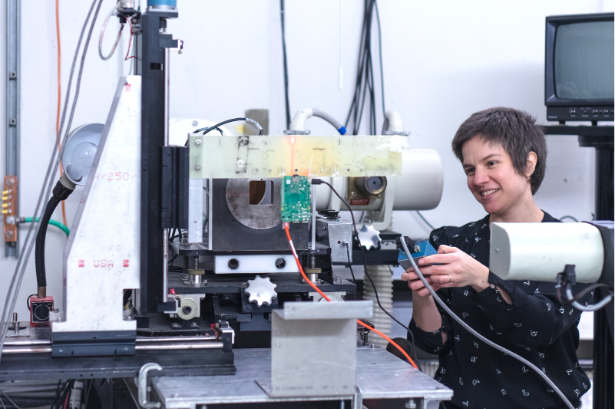
Powered by TRIUMF’s 520 MeV cyclotron, teams of world-leading experts at PIF & NIF deliver proton and neutron beams that closely mimic the radiation environments encountered on the ground, at aircraft cruising altitudes, in low-Earth orbit, and beyond. Just a few minutes in these beams can simulate years’ worth of cosmic exposure, allowing manufacturers, researchers, and mission designers to validate electronic components long before they are deployed.
“TRIUMF is unique in its capability to provide both proton and neutron irradiation facilities that are suitable for testing satellite and aircraft electronics respectively,” said Dr. Alex Hands, PIF & NIF Facility Scientist. “No other facility in the world enables industry to develop protections against harmful radiation effects across the aerospace environment.”
Each year, approximately 200 users from around the world (including CISCO, MDA Space, Samsung, and others) rely on TRIUMF’s cyclotron and PIF & NIF infrastructure to strengthen reliability across defence, aerospace, communications, medical technologies, and other sectors where safety is paramount.
A Strategic Asset for Canada
The A320 recall serves as a cautionary reminder of how interconnected global safety, technology, and science have become.
As Canada’s particle accelerator centre, TRIUMF plays a key role in ensuring the technologies people depend on every day are prepared for the radiation realities of their operating environment. TRIUMF’s irradiation facilities are embedded in these solutions: a homegrown capability that positions Canada as one of only a handful of nations with the infrastructure necessary to provide lifesaving, mission-critical radiation testing at this scale and sophistication.
As Canada seeks to expand its capabilities in areas like aerospace and defence, the need for robust science infrastructure grows. TRIUMF stands at that intersection: an essential contributor to Canada’s science and innovation ecosystem, and a trusted global partner helping keep travellers, satellites, and critical technologies safe every day.
- Read more about PIF & NIF here.
- Read more about Radiation Effects in Electronics here.
- Learn about Radiation Environments with this animated infographic.