
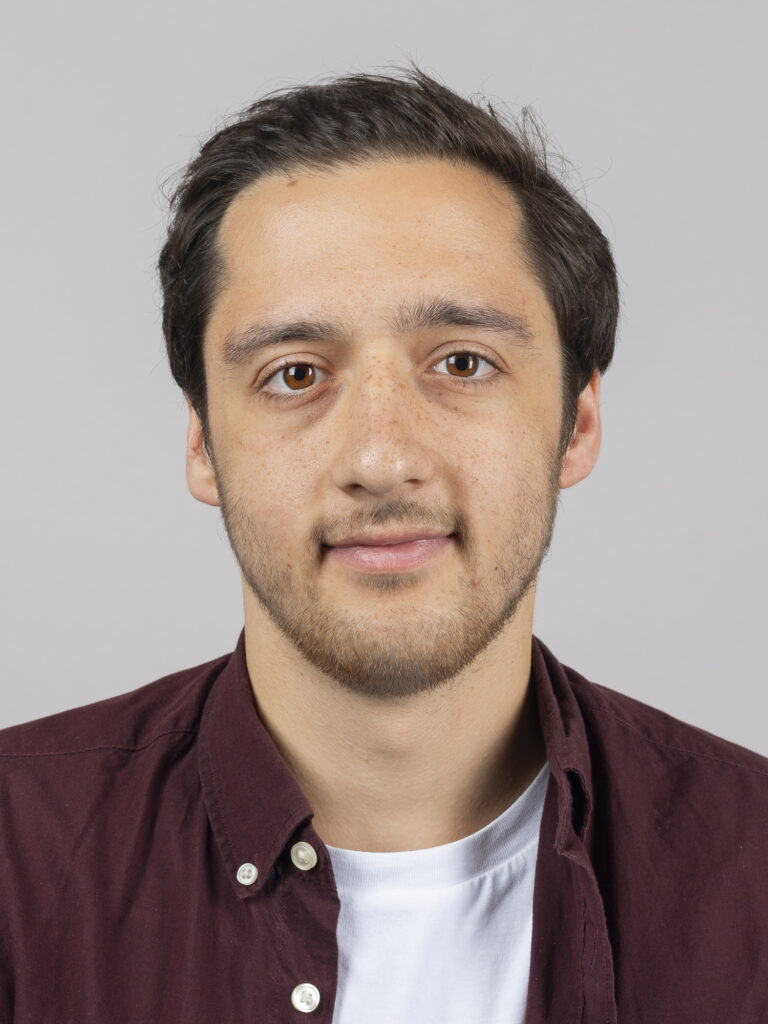
Noah Yazdandoost
Associate Research Scientist
Dr. Noah Yazdandoost is an experimental physicist specializing in the precision measurement of fundamental properties of the neutron. He is currently a member of the TUCAN collaboration at TRIUMF, Canada’s national particle accelerator centre. His research explores some of the most fundamental questions in physics, from the matter-antimatter asymmetry of the universe to probing the limits of the Standard Model through precision measurements of the neutron.
Dr. Yazdandoost’s work focuses on two primary investigations: measuring the neutron’s electric dipole moment and its lifetime using the advanced TUCAN ultracold neutron source at TRIUMF. This next-generation source enables high densities of ultracold neutrons at very low energies that can be stored for prolonged periods, allowing for unprecedented precision in the study of neutron properties.
A nonzero electric dipole moment of the neutron would indicate charge-parity symmetry violation, a phenomenon required to explain the observed imbalance between matter and antimatter in the universe. By measuring (or further constraining) the electric dipole moment of the neutron, Dr. Yazdandoost’s team seeks to either uncover the origin of this imbalance or set tighter limits on extensions of the Standard Model.
The neutron lifetime, another key property under study, is crucial for understanding both the conditions of the early universe and the mechanism of quark mixing. Discrepancies between existing measurement methods remain an open puzzle with the potential for physics beyond the Standard Model.
Ultracold neutrons enable exploration of additional fundamental phenomena, including short-range gravitational interactions, beta decay correlation coefficients that provide precision tests of the weak interaction, and possible neutron decay channels beyond the Standard Model.
By pushing the limits of experimental precision, Dr. Yazdandoost and his team seek to deepen our understanding of the universe at its most fundamental level. Opportunities for undergraduate, graduate, and postdoctoral researchers are available for those eager to engage with these open questions in physics and contribute to this exciting frontier of discovery.